
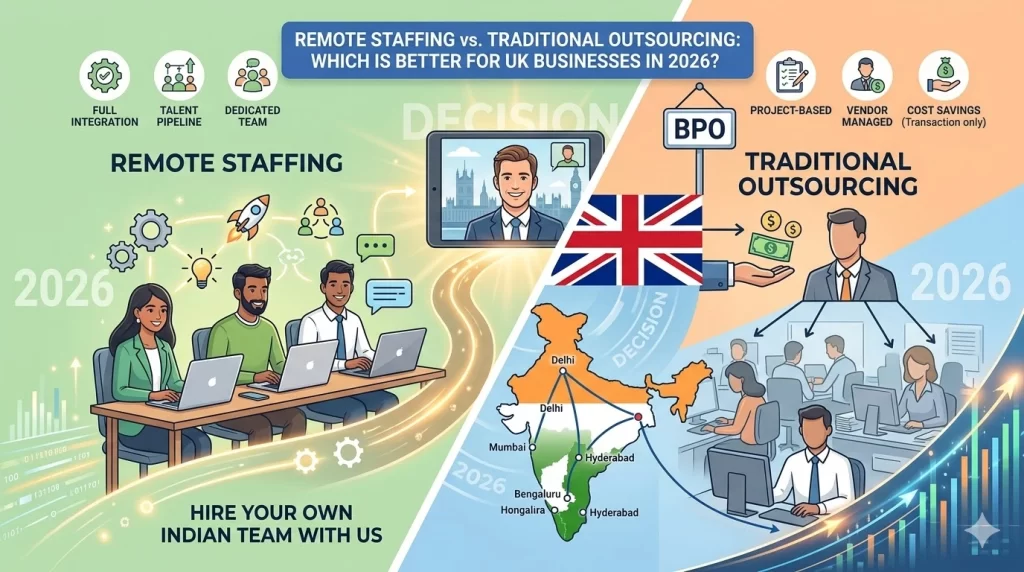
Remote Staffing vs Traditional Outsourcing: Which Is Better for UK Businesses in 2026?
Choosing between remote staffing and traditional outsourcing will matter a lot to UK businesses in 2026. Talent shortages hit record levels last year, with 1.2 million vacancies reported by ONS. Inflation at 3.8% and post-Brexit hiring rules make local staff hard to find and expensive. Many firms now look offshore to stay competitive. This guide uses simple facts and real examples to compare offshore staffing UK options. It helps you make a smart outsourcing comparison UK for your company, whether you’re a startup in London or an established firm in Manchester.
How Traditional Outsourcing Works
Traditional outsourcing means handing tasks to an agency. They use their own teams, often based offshore in places like India or the Philippines. It works well for big, repeat jobs like data entry or basic customer help.
You save money at first, often 50-70% less than UK wages. But there are problems. Teams split time between clients, so focus slips. New projects take 4-6 weeks to start. Time zones (4-5 hours apart) cause mix-ups. When a job ends, knowledge is lost, and costs rise by 20% next time. A 2025 Deloitte report says 42% of UK firms faced these issues.
Why Choose Remote Staffing
Remote staffing UK lets you directly hire your own offshore team, who work exclusively for you, acting like natural extensions of your existing staff. Source talent from strong hubs like India or Ukraine, and integrate them seamlessly with the tools your team already uses, from Slack to project trackers.
This model excels in UK remote team management, with setups completing in just days rather than weeks. Regular video calls align their approach with UK work rhythms, while skills develop steadily over time as they gain deep familiarity with your operations. In 2026, AI-powered tools further simplify cross-time-zone collaboration, handling scheduling and updates effortlessly. Studies highlight 25-40% improved results for tech, marketing, or creative roles, making offshore remote staffing benefits clear for growing UK businesses.
Side-by-Side Comparison
Here’s a clear table for remote staffing vs traditional outsourcing:
| Factor | Traditional Outsourcing | Remote Staffing |
| Team Focus | Shared with other clients | Works just for you |
| Start Time | Weeks for contracts | Days to hire |
| Flexibility | Hard to change | Easy to grow or shrink |
| New Ideas | Basic setups | Tailored and creative |
| Leaving Costs | Fees and lost knowledge | Low and simple |
| Results Check | Reported by the agency | You track directly |
| Cost Control | Fees can surprise | Steady pay, 40-70% less than UK |
| Risks | High from less control | Low with your rules |
What’s Next in 2026
UK regulations are easing to support hiring offshore teams, paving the way for smoother remote staffing UK adoption. Forecasts suggest half of UK firms will embrace remote models by the end of 2026, driven by ongoing talent needs. Hybrid work has become the standard, blending flexibility with productivity.
AI is stepping in to handle repetitive tasks, freeing UK businesses to prioritise skilled oversight and strategy. To bridge time zone gaps effectively, consider recruiting for London-aligned hours or leaning on async tools like Notion for seamless updates. Expect dedicated offshore teams to grow by 60% by 2027, shaping the future of offshore hiring in the UK.
1. Remote staffing vs traditional outsourcing, which is cheaper?
Remote wins long-term: steady salaries vs agency mark-ups (20-30%). Initial savings similar, but remote cuts training waste.
2. How to manage a remote team with time zones in the UK?
Hire for a 2-3 hour overlap with London (9 am-5 pm). Use Slack async updates, Zoom at set times. Tools like World Time Buddy help.
3. Is offshore staffing legal for UK companies?
Yes, GDPR-compliant contracts needed. Direct hires via platforms like Deel handle tax/IP. No visa issues for pure remote.
4. Remote vs outsourcing: quality difference?
Remote better dedicated focus vs shared agency teams. 68% UK firms report higher output (PwC 2025).
5. Best countries for offshore staffing in the UK?
India (skills, English), Poland/Ukraine (time zones, tech), Philippines (service roles).
6. How long to set up a remote team?
7-14 days vs 4-6 weeks for agencies. Video interviews speed it up.
7. What if the remote worker underperforms?
Clear KPIs from day 1, weekly check-ins, 30-day trial. Easier replacement than agency contract fights.