
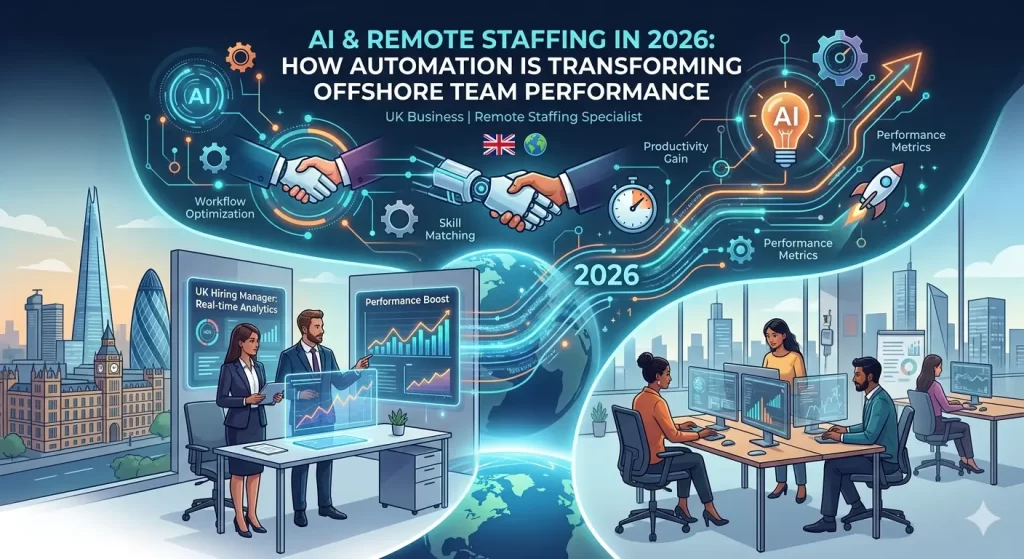
AI and remote staffing have become essential for UK businesses facing skills gaps, wage pressures, and the need for 24/7 operations. Remote staffing connects you with skilled offshore professionals who join your team as full members. In 2026, AI elevates this model by automating routine tasks, improving collaboration, and delivering measurable performance gains.
This guide explores exactly how AI enhances offshore team performance, with practical examples and strategies tailored for UK organisations. Whether you’re new to remote staffing or looking to optimise an existing setup, these insights can help you achieve 20-40% efficiency improvements.
Why AI and Remote Staffing Work So Well Together
Remote staffing provides access to global talent at 40-70% lower costs than UK hires. AI amplifies this by handling repetitive processes, allowing offshore staff to focus on high-value work requiring human insight.
Recent data shows UK firms using AI with remote teams report 30% faster project delivery and 25% higher satisfaction rates. The combination addresses common pain points like time zones and oversight, creating lean, high-performing units.
Faster Hiring and Smoother Onboarding
AI streamlines recruitment by scanning thousands of profiles for skills, experience, and cultural fit. For a marketing role, it might prioritise candidates fluent in UK English with proven campaign results, cutting hiring time from weeks to days.
Onboarding benefits from personalised AI learning paths. New offshore hires complete interactive modules on your processes, tools, and expectations, with progress tracked automatically. This ensures consistency, vital when your team spans continents and reduces the typical 2-4 week ramp-up period.
Automating Routine Work for Better Results
AI frees offshore teams from drudgery, boosting output quality and speed. Instead of manual data sorting or basic drafting, staff handle analysis and decision-making.
Key Tasks AI Can Handle
● Data extraction and entry from emails, forms, or spreadsheets
● Drafting reports, emails, or social media posts
● Customer query responses for standard issues
● Content tagging, scheduling, and basic SEO optimisation
● Invoice processing and expense tracking
A UK e-commerce firm, for instance, used AI to automate 60% of order processing for its offshore support team, allowing focus on complex queries and cutting errors by 35%.
Solving Communication and Time Zone Issues
With 4-12-hour time differences common in offshore staffing, delays once plagued UK teams. AI now summarises discussions, translates nuances, and generates daily digests. Tools prioritise urgent items and suggest responses, so a 9 am London review covers overnight offshore progress.
Video call AI transcribes meetings, extracts action items, and assigns tasks, eliminating “who does what” confusion. This creates async workflows where offshore staff contribute effectively during their peak hours.
Real-Time Tracking Without the Micromanagement
AI dashboards provide live insights into task completion, bottlenecks, and quality scores without constant check-ins. Spot trends like slow data processing, then offer targeted training.
For quality, AI scans outputs for errors or inconsistencies, flagging 90% of issues before review. UK managers gain confidence through metrics like “95% on-time delivery” rather than gut feel, fostering trust in offshore performance.
Strengthening Security and Compliance
Data risks worry 65% of UK firms using remote staffing. AI monitors access patterns, detects anomalies, and enforces policies like GDPR-compliant data handling. Automated audit logs activities for easy compliance proof. Offshore teams benefit from guided workflows that minimise errors, reducing breach risks by up to 50%.
Is This Right for Your UK Business?
AI-driven remote staffing suits SMEs and enterprises in tech, marketing, customer service, or admin-heavy sectors. Expect 40-60% cost reductions versus UK staff, plus scalability for peaks.
Challenges like initial setup (2-4 weeks) and change management exist, but returns justify them. In 2026, with hybrid work standard and AI maturing, UK leaders ignoring this miss a strategic edge. Build your offshore team with automation at the core for resilient, future-proof performance.
1. How is AI used in remote staffing?
AI in remote staffing is used to screen candidates, match skills to roles, automate onboarding, and support daily workflows such as scheduling, reporting, and documentation. It helps UK businesses build offshore teams faster and with better role fit.
2. Can AI really improve remote workforce productivity?
Yes. Studies in 2026 show companies that integrate AI into remote workflows report significantly higher productivity than those using traditional management alone, largely because automation reduces time spent on repetitive tasks and coordination overhead.
3. How can a UK business start using AI in remote staffing?
Start by identifying repetitive tasks in your remote workflows, then introduce AI tools that integrate with existing platforms. Train your offshore staff to use them effectively, set clear KPIs, and review performance data regularly to refine your setup.
4. Does AI replace remote staff or support them?
In most UK organisations, AI is used to support remote teams, not replace them. Automation handles repetitive steps, while people handle judgment, creativity, relationship-building, and oversight, which leads to better overall performance.
5. How does AI help with communication in remote teams?
AI improves communication by summarising long threads, translating where needed, tagging priorities, and generating meeting notes with clear actions. This reduces misunderstandings across time zones and keeps everyone aligned without constant live meetings.